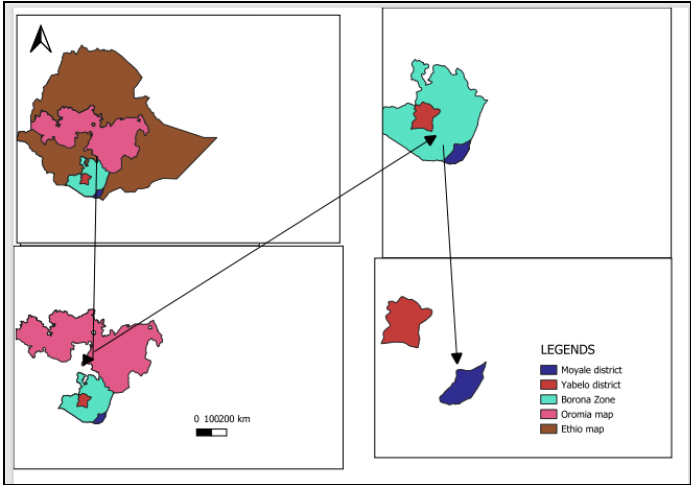
Small ruminants play an important role in the livelihoods of pastoral communities; however, brucellosis, an infectious bacterial disease caused by the genus Brucella, continues to pose a significant threat to both public and animal health in these areas. The prevalence of brucellosis and the level of community awareness of the disease in the study areas had not previously been well characterized. A cross-sectional study was conducted from January 2024 to May 2025 to estimate the seroprevalence and associated risk factors of brucellosis, and to assess herders' knowledge, attitude, and practice (KAP) regarding the disease in the Moyale and Yabello districts of Ethiopia. A total of 484 blood samples were collected: 242 from Moyale (167 goats and 75 sheep) and 242 from Yabello (167 goats and 75 sheep). Samples were screened using the Rose Bengal plate test (RBPT), and positive samples were confirmed using the complement fixation test (CFT). Of the samples tested, 5.6% (27/484) were seropositive by RBPT, and 70.4% (19/27) of RBPT-positive samples were confirmed positive by CFT. All data were analyzed using SPSS software. Multivariable logistic regression analysis revealed that sex and history of retained fetal membrane were significantly associated with brucellosis seroprevalence (female vs. male, OR = 4.98, P = 0.013; retained fetal membrane, OR = 2.5, P < 0.001). A questionnaire survey was administered to 110 small-ruminant owners to assess their knowledge, attitude, and practice regarding brucellosis. Overall, 43.6% of respondents were aware of brucellosis, but only 5.5% knew that the disease could be transmitted from animals to humans. Approximately 70% (77/110) of respondents assisted their animals during kidding and lambing, yet 89.1% (98/110) did not use any protective equipment, posing a risk of zoonotic transmission. In conclusion, brucellosis remains a public and animal health challenge in the pastoral areas of Moyale and Yabello. Integrated disease-control strategies and community education programs are urgently needed to mitigate the impact of brucellosis on both livestock and human populations.


 Review Article
